
 By
Q: What actually makes a relationship healthy?
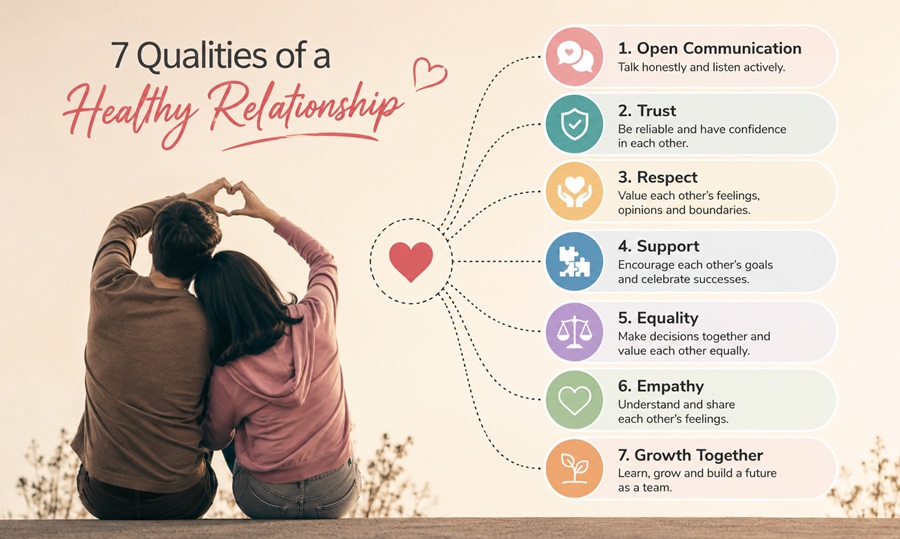
A: Relationship researchers generally point to seven recurring qualities — trust, communication, respect, individuality, conflict resolution skills, shared responsibility, and mutual support — as the strongest predictors of long-term relationship satisfaction.
Below, each one broken down with what it looks like in practice.
Q1: Why is trust considered the foundation?
Without trust, every other quality becomes harder to sustain — communication turns guarded, and conflict resolution becomes about winning rather than understanding. Trust shows up as consistency between what someone says and does, and a general sense of safety without needing constant reassurance.
Q2: What does healthy communication actually look like day to day?
It’s not the absence of disagreement — it’s the presence of honesty without cruelty. Healthy couples tend to say what they mean directly rather than hinting, and they listen to understand rather than just waiting for their turn to respond.
Q3: How is respect different from just “being nice”?
Respect means valuing your partner’s opinions, boundaries, and autonomy even when they differ from your own. Being nice can mask resentment; respect means engaging honestly, including disagreeing, without contempt.
Q4: Why does individuality matter in a relationship?
Healthy couples maintain friendships, hobbies, and identities outside the relationship. Losing all sense of individual self is a common early warning sign of codependency, not closeness.
Q5: What does good conflict resolution actually involve?
Not avoiding conflict — resolving it constructively. This means addressing the issue itself rather than character attacks, taking breaks when things get too heated, and actually returning to finish the conversation rather than letting it drop unresolved.
Q6: What does shared responsibility look like in practice?
Both partners contributing — not necessarily equally in every category, but fairly overall — to finances, household labor, decision-making, and emotional labor. Persistent imbalance in any of these areas is a common source of quiet resentment.
Q7: How is mutual support different from just being present?
It means actively championing each other’s goals, showing up during hard times without being asked, and celebrating each other’s wins as genuinely as your own.
Quick Reference Table
| Quality | What It Looks Like |
|---|---|
| Trust | Consistency between words and actions |
| Communication | Honest, direct, and non-defensive |
| Respect | Valuing differences without contempt |
| Individuality | Maintained friendships and interests |
| Conflict resolution | Addressing issues, not attacking character |
| Shared responsibility | Fair distribution of labor and decisions |
| Mutual support | Actively championing each other |
Q: Do all seven qualities need to be present for a relationship to be healthy?
Not perfectly, and not all the time — but a relationship consistently missing several of these over a long period usually signals a deeper issue worth addressing directly.
Q: Can a relationship rebuild these qualities if they’ve eroded?
Yes, in most cases, especially with intentional effort and, where needed, professional support — but it requires both partners actively participating, not just one.
Frequently Asked Questions
What’s the single most important quality in a healthy relationship?
Most therapists resist ranking them, since they reinforce each other — but trust and communication are frequently cited as foundational to the rest.
Can a relationship be healthy without perfect communication?
Yes — the goal isn’t flawless communication, but a consistent willingness to repair and improve after missteps.
How do I bring up a missing quality with my partner without starting a fight?
Use specific, non-blaming language — “I’ve been feeling like we don’t get much time together lately” lands very differently than “you never make time for me.”
Is conflict a sign of an unhealthy relationship?
No — conflict is normal and even healthy; what matters is how it’s handled and whether it’s ultimately resolved.
Can these qualities be learned, or are some people just naturally better at relationships?
They can absolutely be learned — communication skills, conflict resolution, and even trust-building are teachable, often through therapy or deliberate practice.
Healthy relationships aren’t the ones without problems — they’re the ones with the skills to work through problems together. If you recognize gaps in some of these seven areas, that’s not a failure; it’s simply where the work starts.







Comments